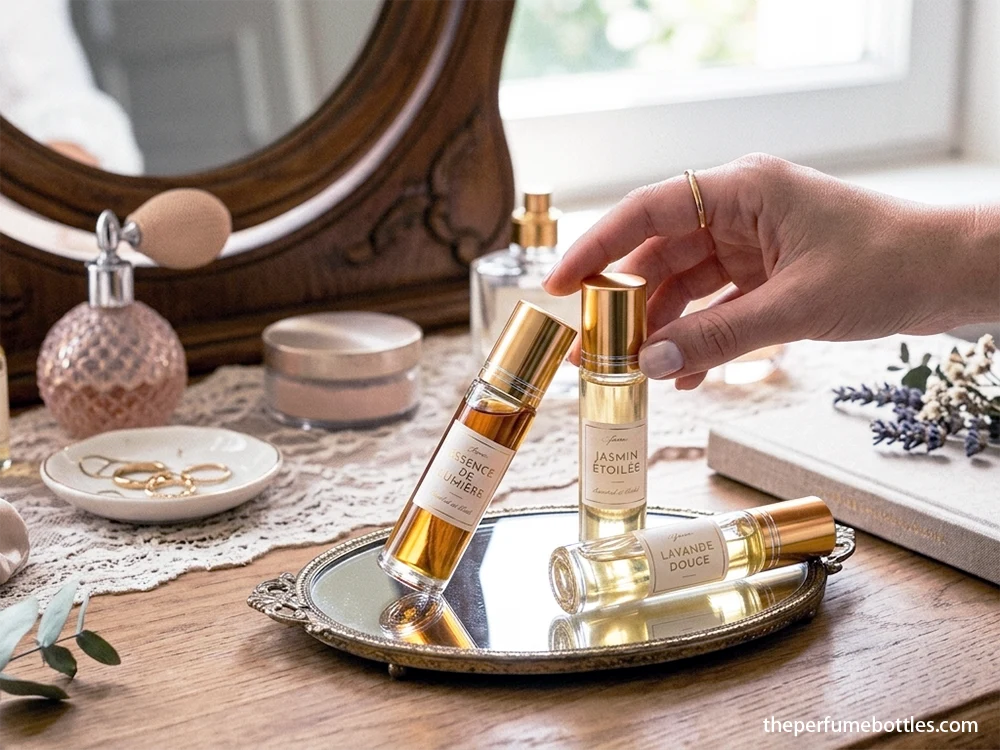
Rollerball Bottles Wholesale: Material Selection & Chemical Compatibility
Table of Contents
Introduction
Three materials. Big consequences.
I’ve reviewed enough rollerball bottles wholesale projects to know that many buyers spend weeks comparing bottle colors, decoration techniques, and printing options, then make a million-dollar purchasing decision based on whichever roller ball happens to be cheapest.
That is backwards.
A rollerball bottle is a complete dispensing system, not simply a glass container. Every component—the glass vial, roller ball, fitment, cap, and sealing interface—must work together while remaining chemically stable for months or even years. One weak component can compromise the entire package.
Well, that’s the awkward one.
In the case of essential oil blends containing limonene, peppermint oil, tea tree oil or ethanol-based fragrance ingredients, do you really know that all the components of the package will stay stable for six months in a warehouse and even after traveling internationally?
Many buyers aren’t.

Why Material Compatibility Matters More Than Price
Price attracts attention.
Compatibility protects profits.
Essential oils are chemical substances that have an active effect. Alcohol based perfumery formulations and citrus oils (d-Limonene) will have a different reaction to metals, plastics, elastomers and coatings, than will clove oil (Eugenol) and peppermint oil (Menthol).
Packaging can affect the quality and stability of the product, and the U.S. FDA declares that packaging materials should be appropriate for the product’s use and that the packaging system should be evaluated as a whole package-closure system.
That is why experienced buyers evaluate compatibility first—and price second.
Understanding Every Component in Rollerball Bottles Wholesale
A roll-on bottle looks simple.
It isn’t.
Typical construction includes:
- Glass bottle
- Roller ball
- Plastic fitment
- Screw cap
- Neck finish
- Internal sealing surfaces
Every component influences:
- Chemical resistance
- Leakage performance
- Application smoothness
- Filling efficiency
- Shipping reliability
- Shelf life
Ignoring one component often creates failures that appear months after production.
Glass Rollerball Bottles Wholesale
Glass remains the preferred material for premium essential oils.
Why?
Glass is chemically inert, highly resistant to essential oils, and preserves fragrance integrity better than most plastics.
Benefits include:
- Excellent chemical stability
- Premium appearance
- High scratch resistance
- Compatible with alcohol-based perfumes
- Easy to recycle
- Suitable for luxury branding
Glass also works well with sensitive botanical formulations that might attack lower-grade plastics over time.
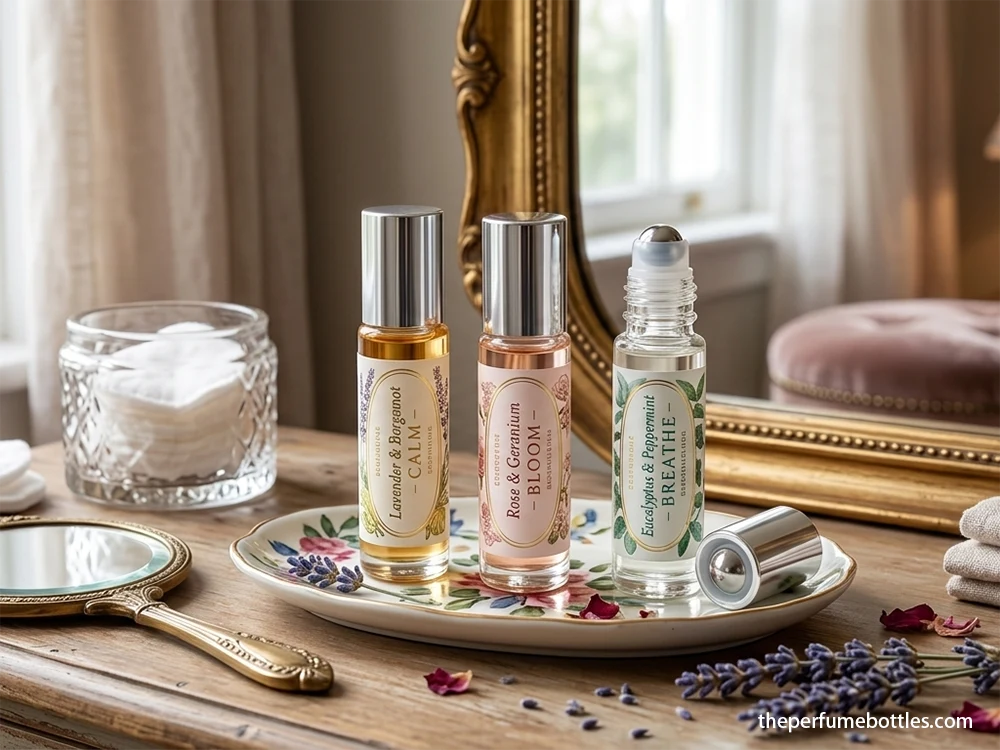
Many commercial 10 ml roller bottles supplied for essential oils combine glass bottles with stainless steel roller balls and FDA-compliant components.
Stainless Steel vs Glass Roller Balls
This debate appears constantly across Reddit, perfume communities, and B2B packaging forums.
Both materials work.
Neither is perfect.
Stainless Steel Roller Balls
Advantages
- Smooth rolling
- Excellent durability
- Strong wear resistance
- Better dispensing consistency
- Ideal for high viscosity oils
- Corrosion resistant with high grade stainless steel use
Disadvantages
- Slightly higher cost
- This can cause corrosion with high-grade formulations in lower-grade alloys.
High quality essential oils are recommended to be manufactured using stainless steel as it helps to prevent corrosion as compared to the common metals and provides a smooth application.
Glass Roller Balls
Advantages
- Completely inert
- No metallic interaction
- Premium perception
- Suitable for sensitive botanical products
Disadvantages
- Less durable under impact
- Slightly less smooth during application
- Higher breakage risk during transportation

Chemical Resistant Rollerball Bottles
Chemical resistance isn’t determined by the bottle alone.
It depends on every material inside the package.
| Component | Recommended Material | Compatibility |
| Bottle | Soda-lime or borosilicate glass | Excellent |
| Roller Ball | Stainless steel 304/316 | Excellent |
| Roller Ball | Glass | Excellent |
| Fitment | PP (Polypropylene) | Very Good |
| Cap | PP or Aluminum with liner | Very Good |
| Seal | PE or compatible liner | Depends on formulation |
When sourcing rollerball bottles wholesale, always request compatibility testing using your actual formulation—not a generic oil.
Essential Oil Roller Bottle Packaging Materials
Different oils behave differently.
Examples include:
| Product | Packaging Recommendation |
| Lavender Oil | Glass + Stainless Steel |
| Peppermint Oil | Glass + Stainless Steel |
| Citrus Oils | Amber Glass + Stainless Steel |
| Perfume Oils | Glass + Stainless Steel |
| Carrier Oils | Glass or Premium Plastic |
| Alcohol Perfume | Glass Bottle + Chemical Resistant Components |
Amber vs Clear Glass
Clear bottles are often selected to please customers by allowing them to see the product.
That’s understandable.
Many essential oils are however destroyed by UV exposure.
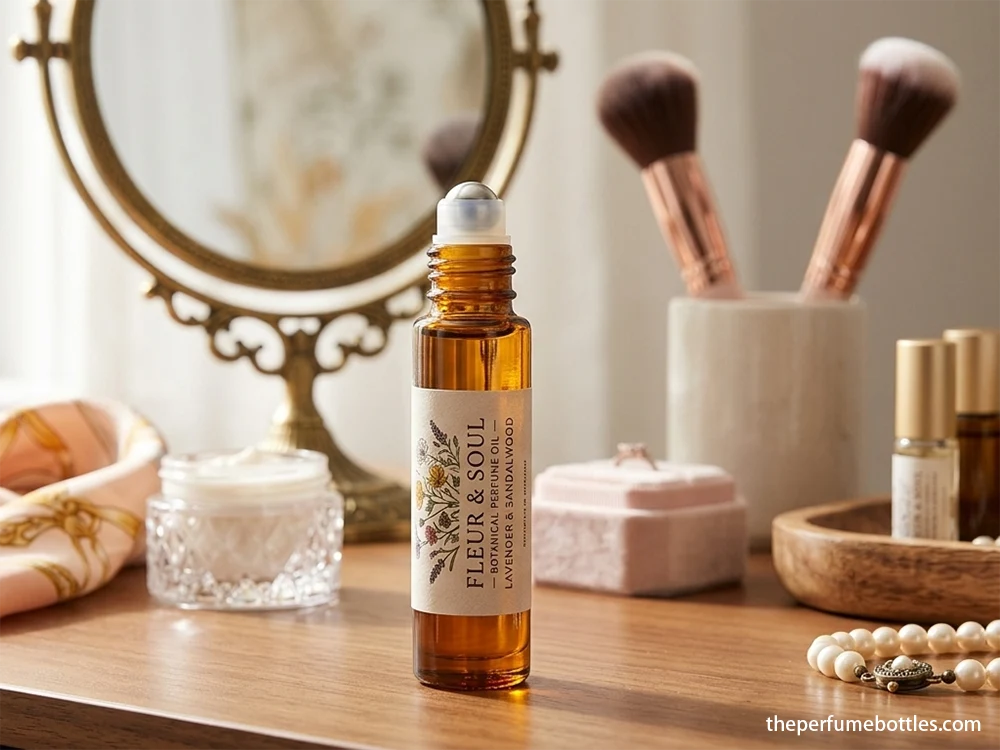
Clear glass is far from being the optimal material for light-sensitive formulations, as amber, green and violet glass are much more protective. Amber glass is the most common packaging choice for essential oils, as it allows for lower levels of light exposure and greater product stability.
Questions Every Wholesale Buyer Should Ask
When you are considering approving production, you should ask your supplier:
- What type of stainless steel is used?
- What is the material made of for the roller ball? 304 or 316 stainless steel?
- Has compatibility testing been completed?
- Which plastic resin is used in the fitment?
- Is the cap torque tested?
- Are leak tests performed on every batch?
- Are dimensional tolerances documented?
- Is there an AQL inspection report?
- Can batch traceability be provided?
- What oils were used during compatibility validation?
Professional suppliers answer these immediately.
Others usually avoid the discussion.
Supplier Comparison Checklist
| Evaluation Item | Basic Supplier | Professional Supplier |
| Material specification | Basic | Complete |
| Roller ball grade | Unknown | 304/316 Stainless |
| Leak testing | Random | Batch tested |
| Chemical compatibility report | No | Yes |
| AQL inspection | Sometimes | Standard |
| Batch traceability | Limited | Full |
| Custom branding | Limited | Full support |
| Export packaging | Basic cartons | Reinforced pallets |

Common Mistakes Buyers Make
We see the same purchasing mistakes repeatedly.
Buying only on price.
Ignoring roller ball material.
Skipping compatibility testing.
Assuming every “glass bottle” uses identical components.
Not requesting QA documentation.
Failing to verify cap torque specifications.
Ordering large quantities before pilot testing.
Each one increases risk.
Combined together, they create expensive warranty claims.
How We Evaluate Rollerball Bottles Wholesale
Our evaluation process follows five steps:
- Review product formulation.
- Match compatible glass and roller materials.
- Verify component specifications.
- Perform leak and compatibility testing.
- Validate production consistency before mass manufacturing.
- This process dramatically reduces quality issues after export.
FAQs
Rollerball bottles wholesale are just that: bottles that are sold wholesale
Rollerball bottles wholesale are the bottles for the cosmetic, essential oil, perfume, aromatherapy, and skin care industry that are manufactured in bulk quantities and can be custom branded, materials, and packaging options.
By buying wholesale, customers can achieve lower per unit prices, and ensure the quality is uniform from batch-to-batch.
What is the best material for essential oil roller bottles?
When it comes to essential oils, the use of glass bottles in combination with stainless steel roller balls is usually the best choice as it offers superior chemical resistance, product stability, reduced risk of corrosion and premium cosmetic packaging applications.
Glass offers excellent storage qualities too.
Which is better, stainless steel roller balls or glass?
Typically, stainless steel roller balls are used for more smooth application and more durability than glass roller balls; glass are typically a preferred choice for a higher-end botanical formulation that requires maximum compatibility.
This decision will depend on formulation, cost and brand positioning.
Is it safe to use essential oils on plastic parts?
Yes. Some essential oils, especially citrus oils rich in limonene and other potent botanical components, may, over time, have an effect on poorer quality plastics, so it’s vital to test compatibility before choosing wholesale essential oil packaging.
Do always test the actual formulation before mass production!
What information does a wholesale supplier need to have on quality papers?
The material specification, dimensional inspection report, leak-test report, AQL inspection report, batch-traceability document and compatibility testing data are all material properties that should be provided by the professional rollerball bottle suppliers if they have.
These documents lessen the sourcing risk and make supplier qualification easier.

Final Thoughts
Buying rollerball bottles wholesale isn’t simply about selecting a 10 ml glass bottle.
You are choosing a dispensing system that will have to resist filling, shipping, storage in the warehouse, handling at the retail shop, and use by the consumer without leaking, corroding or harming the product inside.
Professional buyers do not make comparisons from bottle to bottle.
They compare systems.
When considering suppliers for essential oil, perfume or skin care packaging, ask for detailed material information, compatibility tests, and Quality Assurance documentation before your next large bulk order. It’s that extra effort today that will save you money in quality problems once your products are in the marketplace!
Comments
Product Categories
Hot Sale Bottles

How Custom Perfume Bottles Wholesale Boost Brand Value
See how custom perfume bottles wholesale can elevate your fragrance brand through distinctive designs, premium finishes, and memorable packaging.

How to Choose a Luxury Cosmetic Packaging Wholesale Supplier?
Learn how to select a luxury cosmetic packaging wholesale supplier based on customization options, quality standards, lead times, and pricing strategies.

Case Study: Custom Clear Glass Roll On Bottles for Canada Brand
Learn how we provided custom clear glass roll on bottles for a Canada brand with quality materials, precise roller performance, and scalable manufacturing.

Roll On Bottles Wholesale Market Trends in 2026
Explore how roll on bottles wholesale is evolving with sustainable glass packaging, premium designs, refillable solutions, and growing beauty market demand.

Case Study: Custom Glass Amber Dropper Bottles Manufacturing for a German Fragrance Brand
Custom glass amber dropper bottles with flawless color uniformity, UV protection, and premium quality—crafted for skincare and essential oils.
- +86 186 5178 1159
- [email protected]
- Mon-Sun 07:00-21:00
Tags

Which Materials Are Best for Travel Cream Jars?
Compare travel cream jars and tubes to find the best packaging for your product based on convenience, protection, and user experience.

How Personalised Perfume Bottles Help Brands Stand Out
See how personalised perfume bottles combine premium glass, custom finishes, and scalable manufacturing for fragrance brands.

Case Study: Custom Cologne Bottle Boosts Italian Brand Redesign
Explore how custom cologne bottles solutions enabled Italian fragrance brands to elevate packaging quality and stand out in a competitive market.

Case Study: Customized Perfume Bottle for Swiss Niche Luxury Brand
Discover how our customized perfume bottle helped a luxury Swiss fragrance brand enhance packaging design, branding, and premium positioning.